Best Walkers for Seniors: Safer Picks for Stability, Support, and Everyday Use

Choosing the best walker for a senior is not about chasing the most popular model or the one with the longest feature list. It is about finding the walker that fits the person, the home, and the way it will actually be used every day.
Some older adults need maximum stability and a simpler frame. Others do better with a rollator that is easier to push and includes a seat for breaks. The right choice depends on balance, strength, walking habits, home layout, and whether the person can safely manage the walker on their own.
In this guide, we break down the best walkers for seniors by situation, what to look for before buying, and the most common mistakes families make when choosing mobility support.
Best walker types for different needs
- Best for maximum stability: Medline Lightweight Two Button Folding Walker with 5" Wheels
- Best for everyday comfort: Drive Medical Rollator Walker with Seat
- Best lightweight rollator: Drive Medical Aluminum Rollator Walker
- Best premium everyday rollator: Drive Medical Hugo Elite Rollator Walker with Seat
- Best for larger users: Medline Heavy-Duty Bariatric Folding Walker with 5" Wheels
Not every senior should use the same walker type. The safest option depends on how much support they need, how steady they are on their feet, and how the walker will be used around the home and outside.
Our Top Walker Picks for Seniors
These picks are organized by real-life needs, not empty hype.
Medline Lightweight Two Button Folding Walker with 5" Wheels
Best for seniors who need a steadier frame and more direct support for indoor walking.
Check Price on AmazonDrive Medical Rollator Walker with Seat
Best for seniors who walk more often and benefit from smoother movement plus a built-in seat.
Check Price on AmazonDrive Medical Aluminum Rollator Walker
Best for seniors who want a lighter rollator that is easier to fold, carry, and store.
Check Price on AmazonWhen a walker may be worth considering
This guide may help if you are shopping for:
- An older adult who feels less steady while walking
- A parent recovering after illness, injury, or hospitalization
- Someone who has started holding onto furniture or walls
- A senior who gets tired standing or walking for longer periods
- A caregiver comparing walkers and rollators
A walker is not always the answer, but it is often worth considering when balance, walking confidence, or daily mobility starts to decline.
How we looked at walker options
When comparing walker options for seniors, we focus on practical factors that affect real daily use:
- Overall stability and support
- Ease of turning and steering
- Handle height adjustment
- Frame width for indoor use
- Brake usability for rollators
- Weight capacity
- Comfort during regular use
- Ease of folding, storing, and transporting
- Suitability for the home environment
If you want to understand our approach in more detail, read our How We Evaluate page.
Best walkers for seniors by situation
1. Medline Lightweight Two Button Folding Walker with 5" Wheels
Best for: Seniors who need maximum stability and a more supportive indoor walking setup.
Why it stands out: This style is often a strong choice for older adults who want a steadier feel and do not need the extra movement speed or seat of a rollator.
What we like:
- Steadier feel for many users
- Simple design that is easier to understand
- 5-inch front wheels help movement feel smoother indoors
- Good fit for users who prioritize support over speed
What to consider:
- May feel slower than a rollator
- Less convenient for longer outings
- Needs proper height adjustment to work well
2. Drive Medical Rollator Walker with Seat
Best for: Seniors who walk more often and benefit from smoother movement plus a seat for rest breaks.
Why it stands out: This rollator is built around easier movement, a foldable frame, and a higher weight limit that can suit many everyday users.
What we like:
- Smoother movement than many standard walkers
- Built-in seat for rest breaks
- 7.5-inch wheels help with everyday indoor-outdoor movement
- 350 lb weight limit gives it broader usefulness
What to consider:
- Not always the best choice for someone who needs firmer support
- Brakes must be easy for the user to manage
- May feel bulky in tight indoor spaces
3. Drive Medical Aluminum Rollator Walker
Best for: Seniors who want a lighter rollator that is easier to fold, store, and transport.
Why it stands out: This model leans more toward portability, making it easier for some users and caregivers to move in and out of a car or store away.
What we like:
- Lightweight portable design
- 6-inch wheels keep the frame compact
- Padded seat adds convenience for breaks
- Better fit for people who do not want a heavier steel rollator
What to consider:
- Lighter is not always better if stability is the top priority
- Smaller wheels may be less forgiving on rougher outdoor surfaces
4. Drive Medical Hugo Elite Rollator Walker with Seat
Best for: Seniors who want an everyday rollator with larger wheels and a more premium feel.
Why it stands out: Its 8-inch wheels can make everyday maneuvering feel smoother across more surfaces than smaller-wheel models.
What we like:
- 8-inch wheels for easier maneuverability
- Seat, backrest, and storage basket add convenience
- A strong all-around fit for many everyday users
What to consider:
- Still not the best pick for someone who needs maximum direct support
- Can take up more room than a simpler standard walker
5. Medline Heavy-Duty Bariatric Folding Walker with 5" Wheels
Best for: Larger users who need a higher weight capacity and a sturdier frame.
Why it stands out: This is the stronger fit when a standard walker frame may not feel substantial enough for the user’s size or support needs.
What we like:
- 500 lb weight capacity
- Heavy-duty frame feel
- 5-inch wheels help with smoother front movement
- Better fit for users who need more structural support
What to consider:
- Heavier to move and transport
- May be too wide or bulky for some indoor setups
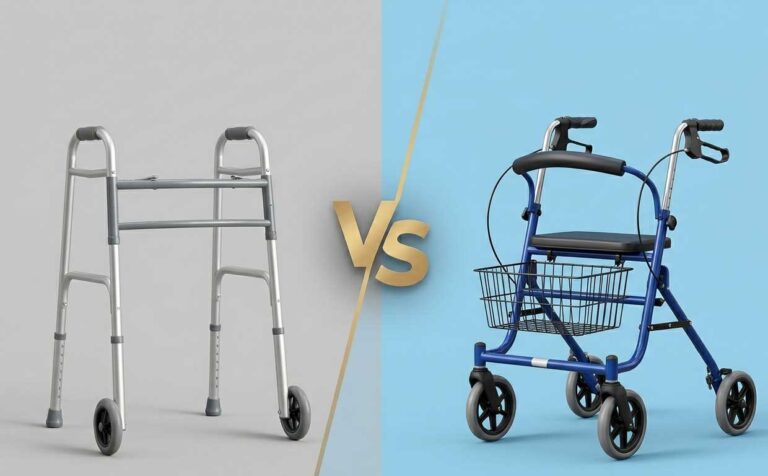
Which is better for seniors?
A standard walker is not automatically better than a rollator, and a rollator is not automatically the smarter choice.
A standard walker is often better when:
- Maximum stability matters most
- The person is cautious or unsteady
- Indoor use is the main priority
- The user may not manage hand brakes safely
A rollator is often better when:
- The person walks more independently
- Smoother movement matters
- Longer distances are more common
- Rest breaks would be helpful
- The user can safely control the brakes
The safest choice depends less on what looks modern and more on what the person can actually use confidently and safely.
What to look for in a walker for seniors
1. Stability first
If the walker feels shaky, awkward, or hard to control, that is a serious problem. Support should come before features.
2. Correct handle height
Handle height affects posture, comfort, and control. A badly fitted walker can make walking harder instead of easier.
3. Frame width for the home
Measure doorways, bathroom entrances, and narrow indoor areas before buying. A walker that catches on furniture constantly is a bad fit.
4. Weight capacity
This matters more than many families think. The walker should support the person confidently and appropriately.
5. Brake usability
If you are choosing a rollator, the brakes should be easy to squeeze and control.
6. Foldability and transport
If the walker needs to fit in a trunk, closet, or tight hallway, folded size and portability matter.
7. Everyday comfort
Grip shape, turning ease, seat comfort, and general handling affect whether the walker is actually used consistently.
What families often get wrong
Buying based on popularity alone
A highly rated walker is not automatically the right one for your parent’s balance level, hand strength, or home setup.
Choosing convenience over support
A faster or more attractive walker is not necessarily the safer choice.
Ignoring the home layout
A model that is too wide, too bulky, or too awkward for the home may end up being more frustrating than useful.
Picking a rollator too early
Some seniors like the idea of a rollator because it feels smoother and looks more modern, but for someone who needs firmer support, it may not be the safer fit.
Focusing only on price
A cheaper walker that is unstable, uncomfortable, or badly matched can end up unused.
When a walker should not be chosen casually
Extra guidance may be especially important if an older adult has:
- Multiple recent falls
- Rapidly worsening mobility
- Significant weakness on one side
- Dizziness or medical symptoms affecting balance
- Confusion about how to use support equipment safely
A walker can be helpful, but only when it matches the person’s actual needs and abilities.
Common questions about walkers for seniors
The best walker depends on the senior’s balance, strength, walking habits, home layout, and whether they can use the walker safely and consistently. Standard walkers often offer more support, while rollators may offer more convenience for some users.
A walker usually provides more support than a cane, but that does not mean it is always the right choice. It depends on how much support the person actually needs.
They can be, but safety depends on proper fit, the type of walker, the user’s balance level, and the layout of the home.
A standard walker usually prioritizes support and stability. A rollator usually prioritizes smoother movement and convenience, but it may require more control and brake use.
Warning signs include holding onto furniture, appearing unsteady, slowing down out of fear of falling, or struggling with safe movement around the home.
The best walker is the one that fits real life
The best walker for a senior is not the one with the loudest marketing. It is the one that helps the person move more safely, more confidently, and more consistently in daily life.
For some older adults, that means a simple standard walker with solid support. For others, it means a rollator with a seat, a lighter aluminum frame, or a model with larger wheels that feels better for everyday movement. The smarter choice comes from matching the walker to the person and the home instead of chasing generic “best” claims.
Still not sure which walker style is the right fit?
Start with our guide to the warning signs, walker types, and home safety changes that often matter most.

Claire Bennett is the Senior Home Safety Researcher and Editor at ElderlyTend. She writes practical guides that help older adults, caregivers, and families make safer decisions at home. Her work focuses on mobility aids, fall prevention, bathroom safety, bedroom safety, and aging-in-place support.
At ElderlyTend, Claire reviews product categories and home safety topics with a strong focus on real-life usability, comfort, safety, and everyday practicality. Her goal is to make senior care decisions easier to understand without the confusing language, exaggerated claims, or low-value advice that often fills the internet.